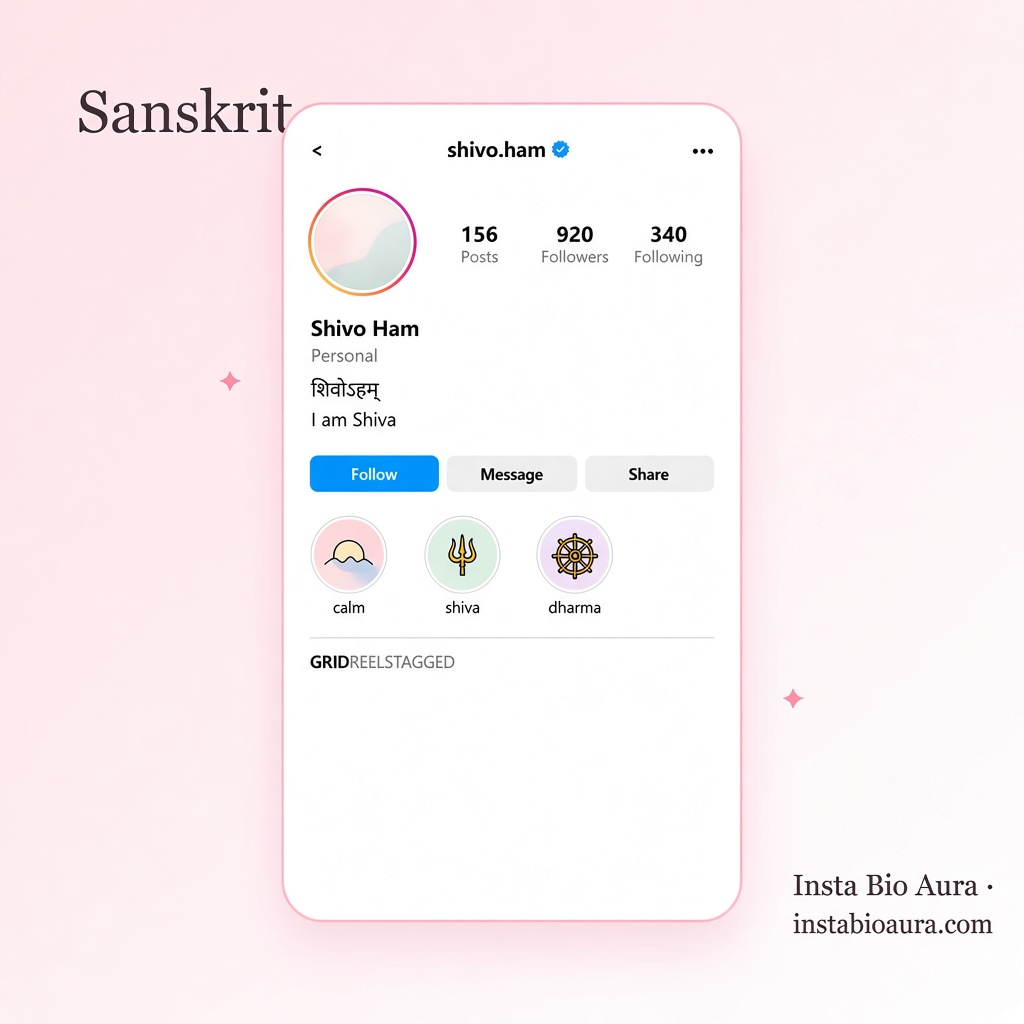

A Sanskrit bio is a short line of Sanskrit, written in Devanagari or Roman letters, placed in the Instagram bio field. Instagram allows 150 characters for that field. The strongest Sanskrit bios run two to five words, carry a verifiable source, and sit beside a short English translation so followers understand them.
40 Sanskrit Bios for Instagram, With Meaning and Pronunciation

Every line below carries four things: the Devanagari, the Roman transliteration, the English meaning, and its source. The character count tells you exactly how much of your Instagram bio each line uses.
Lines marked modern are grammatically correct Sanskrit with no classical source. Lines marked with a text and verse number come from that text.
One-word Sanskrit bios (4–8 characters)
A one-word Sanskrit bio uses a single noun in its nominative form — the form you would actually say. Each one uses 4 to 8 of your 150 characters.
| # | Devanagari | Transliteration | English meaning | Source | Characters |
| 1 | शान्तिः | śāntiḥ | Peace | Classical Sanskrit noun | 7 |
| 2 | आनन्दः | ānandaḥ | Joy | Classical Sanskrit noun | 6 |
| 3 | सत्यम् | satyam | Truth | Classical Sanskrit noun | 6 |
| 4 | धैर्यम् | dhairyam | Patience | Classical Sanskrit noun | 7 |
| 5 | करुणा | karuṇā | Compassion | Classical Sanskrit noun | 5 |
| 6 | विद्या | vidyā | Knowledge | Classical Sanskrit noun | 6 |
| 7 | सेवा | sevā | Service | Classical Sanskrit noun | 4 |
| 8 | मौनम् | maunam | Silence | Classical Sanskrit noun | 5 |
| 9 | तेजः | tejaḥ | Inner fire | Classical Sanskrit noun | 4 |
| 10 | श्रद्धा | śraddhā | Faith, trust | Classical Sanskrit noun | 7 |
Each of these ten is a noun in the nominative singular. That matters, and the reason appears further down under the grammar section.
Two- to four-word Sanskrit bios
These carry a full statement. Most use 11 to 22 characters, which leaves you well over 120 characters for an English line and your role.
| # | Devanagari | Transliteration | English meaning | Source | Characters |
| 11 | सत्यमेव जयते | satyameva jayate | Truth alone triumphs | Muṇḍaka Upaniṣad 3.1.6 | 12 |
| 12 | अहं ब्रह्मास्मि | ahaṁ brahmāsmi | I am Brahman | Bṛhadāraṇyaka Upaniṣad | 15 |
| 13 | तत्त्वमसि | tattvamasi | You are that | Chāndogya Upaniṣad | 9 |
| 14 | वसुधैव कुटुम्बकम् | vasudhaiva kuṭumbakam | The world is one family | Mahā Upaniṣad | 17 |
| 15 | योगः कर्मसु कौशलम् | yogaḥ karmasu kauśalam | Yoga is skill in action | Bhagavad Gītā 2.50 | 18 |
| 16 | कर्मण्येवाधिकारस्ते | karmaṇyevādhikāraste | Your right is to the action alone | Bhagavad Gītā 2.47 | 19 |
| 17 | धर्मो रक्षति रक्षितः | dharmo rakṣati rakṣitaḥ | Dharma protects the one who protects it | Manusmṛti | 20 |
| 18 | अहिंसा परमो धर्मः | ahiṁsā paramo dharmaḥ | Non-violence is the highest duty | Mahābhārata | 17 |
| 19 | विद्या ददाति विनयम् | vidyā dadāti vinayam | Knowledge gives humility | Hitopadeśa | 19 |
| 20 | आत्मदीपो भव | ātmadīpo bhava | Be your own lamp | Buddhist Pāli tradition, Sanskrit form | 11 |
| 21 | उद्यमेन हि सिध्यन्ति | udyamena hi sidhyanti | Through effort things are accomplished | Hitopadeśa | 20 |
| 22 | सर्वे भवन्तु सुखिनः | sarve bhavantu sukhinaḥ | May all be happy | Traditional peace invocation | 19 |
| 23 | न भयम् | na bhayam | No fear | Modern | 6 |
| 24 | चरैवेति | caraiveti | Keep walking | Aitareya Brāhmaṇa | 7 |
| 25 | सा विद्या या विमुक्तये | sā vidyā yā vimuktaye | Knowledge is that which frees | Viṣṇu Purāṇa | 22 |
| 26 | मातृदेवो भव | mātṛdevo bhava | Honour your mother as divine | Taittirīya Upaniṣad | 11 |
| 27 | योगश्चित्तवृत्तिनिरोधः | yogaścittavṛttinirodhaḥ | Yoga is the stilling of the mind | Yoga Sūtra 1.2 | 22 |
| 28 | असतो मा सद्गमय | asato mā sadgamaya | Lead me from the unreal to the real | Bṛhadāraṇyaka Upaniṣad | 14 |
| 29 | तमसो मा ज्योतिर्गमय | tamaso mā jyotirgamaya | Lead me from darkness to light | Bṛhadāraṇyaka Upaniṣad | 19 |
| 30 | शिवोऽहम् | śivo’ham | I am Shiva | Nirvāṇaṣaṭkam | 8 |
| 31 | सत्यं शिवं सुन्दरम् | satyaṁ śivaṁ sundaram | Truth, goodness, beauty | Traditional triad | 19 |
| 32 | यतो धर्मस्ततो जयः | yato dharmastato jayaḥ | Where there is dharma, there is victory | Mahābhārata | 17 |
| 33 | जीवेम शरदः शतम् | jīvema śaradaḥ śatam | May we live a hundred autumns | Ṛgveda | 15 |
| 34 | क्षमा वीरस्य भूषणम् | kṣamā vīrasya bhūṣaṇam | Forgiveness is the brave one’s ornament | Traditional maxim | 19 |
| 35 | मौनं सर्वार्थसाधनम् | maunaṁ sarvārthasādhanam | Silence accomplishes everything | Traditional maxim | 19 |
| 36 | न हि ज्ञानेन सदृशम् | na hi jñānena sadṛśam | Nothing equals knowledge | Bhagavad Gītā 4.38 | 19 |
| 37 | उत्तिष्ठत जाग्रत | uttiṣṭhata jāgrata | Arise, awake | Kaṭha Upaniṣad | 16 |
| 38 | आत्मानं विद्धि | ātmānaṁ viddhi | Know your self | Upaniṣadic teaching | 14 |
| 39 | अतिथिदेवो भव | atithidevo bhava | Treat the guest as divine | Taittirīya Upaniṣad | 12 |
| 40 | परोपकाराय सतां विभूतयः | paropakārāya satāṁ vibhūtayaḥ | The good use their gifts for others | Traditional maxim | 22 |
Two-line Sanskrit bios
Instagram counts a line break as a character. A two-line Sanskrit bio therefore costs both lines plus one.
| Pairing | Characters |
| असतो मा सद्गमय / तमसो मा ज्योतिर्गमय | 34 |
| सत्यमेव जयते / धर्मो रक्षति रक्षितः | 33 |
| शान्तिः / सर्वे भवन्तु सुखिनः | 27 |
| कर्मण्येवाधिकारस्ते / मा फलेषु कदाचन | 38 |
Line 28 and line 29 belong to the same original invocation, which is why they read naturally as a pair.
What Do These Sanskrit Bios Mean in English?
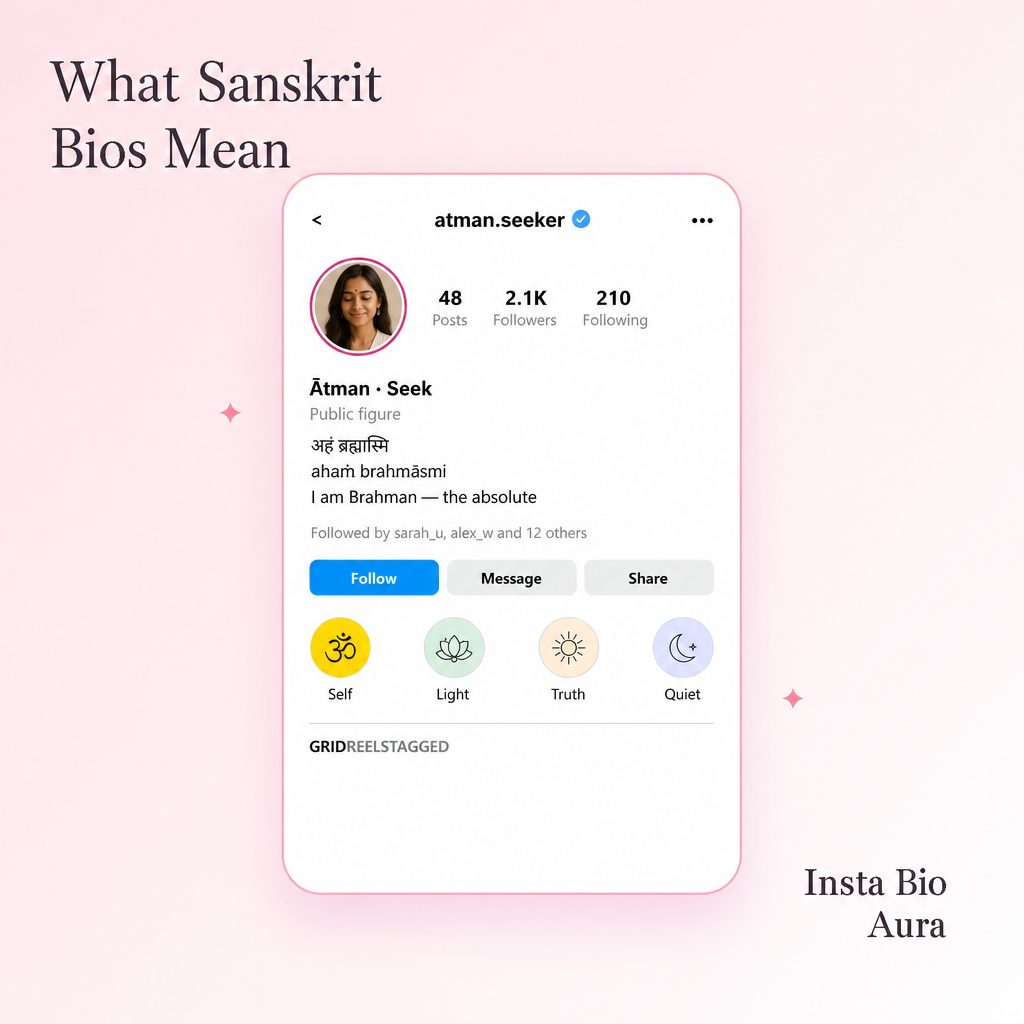
Sanskrit bios carry compressed meanings that English translations often flatten. अहं ब्रह्मास्मि means “I am Brahman” — the absolute, not the physical universe. अहिंसा परमो धर्मः means “non-violence is the highest duty,” not “kindness is my religion.” Accurate translation changes which line suits you.
Ten words carry most of the meaning across the forty lines above. Here is what each one actually says.
Karma (कर्म) means action or deed. Karma does not mean fate or destiny. In कर्मण्येवाधिकारस्ते, the line says your right extends to the action, and stops there.
Dharma (धर्म) means duty, righteousness, or the right order of things. Dharma is not the word for religion. In धर्मो रक्षति रक्षितः, dharma is closer to “the right thing” than to “faith.”
Brahman (ब्रह्म) means the absolute reality. Many bio lists translate अहं ब्रह्मास्मि as “I am the universe,” which points at stars and planets. The line points at something else entirely.
Ātman (आत्मन्) means the self. Its nominative form is आत्मा. The form आत्मन् is a dictionary entry, not a sentence.
Ahiṁsā (अहिंसा) means non-violence. It does not mean kindness, which is a different word — दया.
Free Instagram Bio Generator — Make my bio →
Yoga (योग) means disciplined union. In योगः कर्मसु कौशलम्, the line reads “yoga is skill in action,” and describes how you work rather than how you stretch.
Śānti (शान्ति) means peace. ॐ शान्तिः means “Om, peace.” No word inside it means “mind.”
Mokṣa (मोक्ष) means release from the cycle of rebirth. It is a much larger claim than “freedom.”
Vidyā (विद्या) means knowledge. विद्या ददाति विनयम् says knowledge gives humility, and names humility as the proof of learning.
Layered meaning describes how one Sanskrit compound holds several readings at once. An English gloss picks one reading and drops the rest, which is why two websites can translate the same line differently and both be defensible.
Three corrections are worth stating plainly, because they appear across many published bio collections.
| Line | Common translation | Accurate translation |
| अहं ब्रह्मास्मि | I am the universe | I am Brahman, the absolute |
| अहिंसा परमो धर्मः | Kindness is my religion | Non-violence is the highest duty |
| ॐ शान्तिः | Peace of mind | Om, peace |
How Do You Pronounce a Sanskrit Bio?
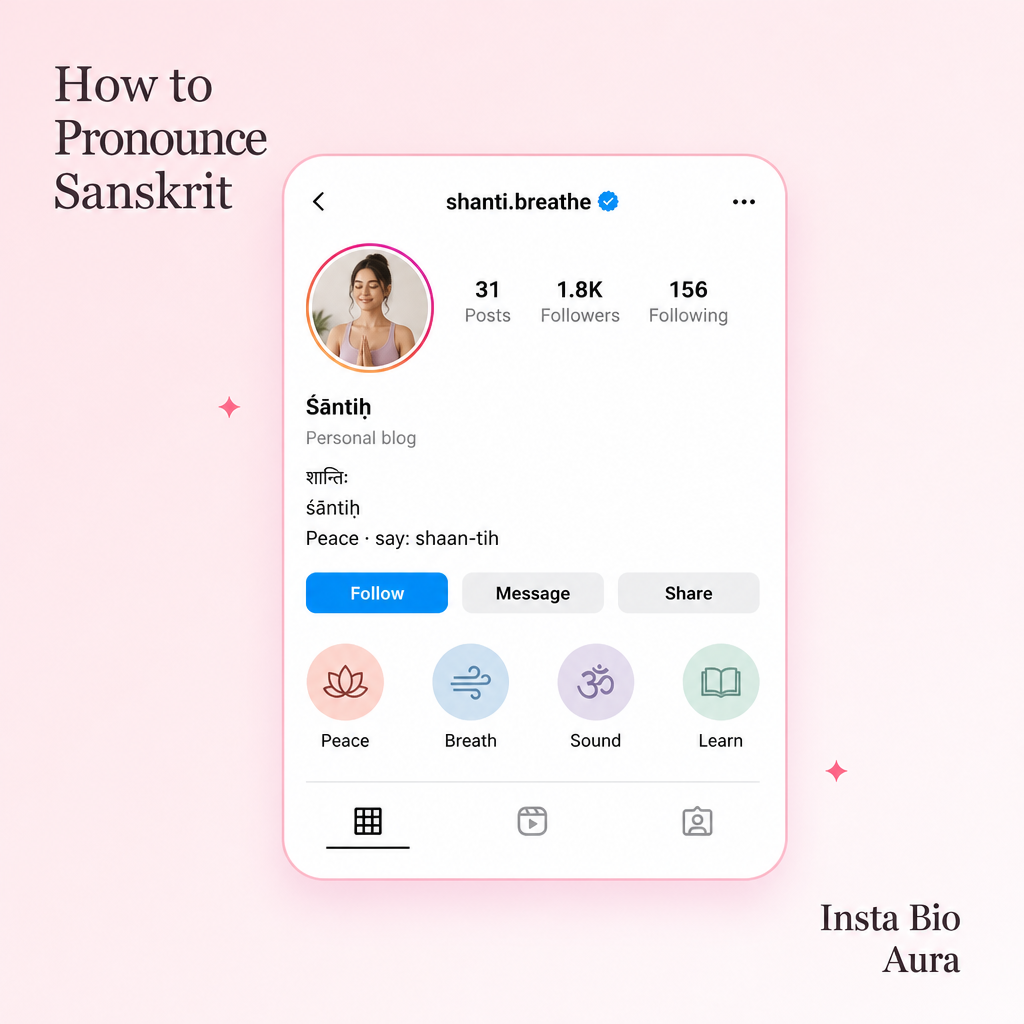
Transliteration writes Sanskrit sounds in Roman letters, so you can say a line without reading Devanagari. IAST — the International Alphabet of Sanskrit Transliteration — gives each Devanagari character one Roman letter, sometimes with a mark above or below it.
Those marks are not decoration. Each one changes the sound.
| Mark | Example | How to say it |
| ā | śāntiḥ | Long a, as in father |
| ī | vidyā dadāti | Long i, as in machine |
| ū | guṇa | Long u, as in rule |
| ṛ | mātṛdevo | Vocalic r, close to ri in rich |
| ś | śāntiḥ | Sh sound, tongue forward |
| ṣ | kṣamā | Sh sound, tongue curled back |
| ṇ ṭ ḍ | kuṭumbakam | Retroflex — tongue tip curled to the roof |
| ṁ | ahaṁ | Nasal hum through the previous vowel |
| ḥ | śāntiḥ | A soft breath echo of the vowel before it |
Reading a line aloud before you post it catches problems the eye misses. A line you cannot pronounce is a line you cannot defend in your comments.
Is This Sanskrit Actually Correct?

Four things go wrong in Sanskrit bios, and none of them is visible to somebody who does not read the language. Each has a test you can apply yourself.
Is this line classical Sanskrit or a modern composition?
A classical line comes from a datable text and can be cited by chapter and verse. A modern composition is grammatically valid Sanskrit written recently, with no textual source behind it. Both work in an Instagram bio. Only one of them is ancient.
The difference matters when somebody asks where your line comes from. सत्यमेव जयते has an answer: Muṇḍaka Upaniṣad 3.1.6. A phrase assembled last year does not, however elegant it looks.
In the table above, line 23 is marked modern for exactly this reason. न भयम् is correct Sanskrit and reads well. It is not a quotation.
| Classical line | Modern composition | |
| Source | Named text, chapter, verse | None |
| Age | Centuries to millennia | Recent |
| Grammar | Fixed by the manuscript | Depends on who wrote it |
| Safe to call “ancient” | Yes | No |
Is this Sanskrit, or is it actually Hindi?
Sanskrit and Hindi share the Devanagari script but are different languages, so a line can look like Sanskrit and be Hindi. Sanskrit builds meaning with case endings attached to the word itself. Hindi builds meaning with small separate words placed after the noun.
Apply this test: if the line contains में, की, से, को, ने, या, है or था, it is Hindi. Those are Hindi postpositions and verbs. Sanskrit does not use them.
Free Instagram Bio Generator — Make my bio →
Two more markers help. Words of Persian or Arabic origin — रूह, दिल, इश्क़, ख़्वाब — never appear in Sanskrit. And a Sanskrit sentence usually ends in a vowel-plus-visarga (ः) or in म्, as in शान्तिः and सत्यम्.
Verb forms such as जपो, करो, चलो and आएंगे are Hindi imperatives and futures. A Sanskrit imperative looks like भव, कुरु or गच्छ instead.
Does this Sanskrit bio work if you are a woman?
Sanskrit marks grammatical gender on adjectives, participles and many self-descriptive words, so a line describing yourself changes shape depending on who is speaking. अहमस्मि योधः means “I am a warrior” in the masculine form. A woman writing that about herself uses योद्धा or वीरा instead.
This is the single most common invisible error in Sanskrit bios. Nobody notices until somebody who reads Sanskrit does.
| Masculine form | Feminine form | Meaning |
| अहमस्मि योधः | अहमस्मि वीरा | I am a warrior |
| निर्भयोऽस्मि | निर्भयास्मि | I am fearless |
| कृतज्ञोऽस्मि | कृतज्ञास्मि | I am grateful |
| शान्तोऽस्मि | शान्तास्मि | I am at peace |
Plain nouns avoid the problem completely. शान्तिः, विद्या, सत्यम्, करुणा and सेवा carry no speaker gender, and any person can post them unchanged. That is one reason the one-word list above sits at the top of this page.
What is sandhi, and why does the spelling change?
Sandhi is the sound change that happens when two Sanskrit words meet, and it changes the spelling of the joined form. सत्यम् plus एव becomes सत्यमेव, written as one word. Writing सत्यं एव instead marks the line as copied from a source that never applied the rule.
A second example: परम् plus सुखम् becomes परमं सुखम्, because the म् takes an anusvāra before the following consonant.
What we checked, and what we did not
Every line on this page was checked for three things: correct nominative or imperative form, correct sandhi, and whether the language is Sanskrit rather than Hindi. Where a line has a classical source, the source is named. Where it does not, the line is marked modern.
Two limits are worth stating. Sanskrit editions differ on the exact wording of several well-known lines. Where editions disagree, we have chosen the most widely printed form rather than pretending a single correct version exists. Second, a source label here names the text a line comes from, not a specific critical edition.
Some phrases did not make the list. These four are widely circulated and each carries a defect.
| Phrase | Why it was cut |
| आत्मन् | Dictionary stem, not a usable form. The nominative is आत्मा |
| न भूतो न भविष्यति | Circulated with the translation “not now, not now.” It means “neither has been nor will be” |
| सरलता परमो धर्मः | Circulated as “the last virtue is simplicity.” Paramo means highest, not last |
| सिंहः एकाक चरति | Ekāka is not a valid form. The standard word is एकाकी |
Several widely circulated phrases failed one of the three checks. The two most frequent failures were a dictionary stem used where a nominative was needed, and Hindi lines filed under a Sanskrit heading.
A shorter checked list gives you fewer options than a list of three hundred. That is the trade. Every line here can be explained if somebody asks.
Which Sanskrit Bio Suits Your Profile?

Choose along two axes: the theme you want to signal, and the length you have room for. This grid places twelve of the forty lines against both.
| One word | Two to four words | Two lines | |
| Stillness | शान्तिः (7) | मौनं सर्वार्थसाधनम् (19) | शान्तिः / सर्वे भवन्तु सुखिनः (27) |
| Resolve | धैर्यम् (7) | न भयम् (6) | उत्तिष्ठत जाग्रत / चरैवेति (25) |
| Self-knowledge | सत्यम् (6) | अहं ब्रह्मास्मि (15) | असतो मा सद्गमय / तमसो मा ज्योतिर्गमय (34) |
| Service | सेवा (4) | सर्वे भवन्तु सुखिनः (19) | सेवा / परोपकाराय सतां विभूतयः (27) |
Stillness suits accounts about meditation, reading, slow work or quiet craft. The lines make no claim about you and age well.
Resolve suits training, study, building something, or recovery. These lines are short by nature, which is why they cost the fewest characters.
Free Instagram Bio Generator — Make my bio →
Self-knowledge suits philosophy, teaching and writing accounts. These are the heaviest lines on the page in meaning, and अहं ब्रह्मास्मि in particular is a major Upaniṣadic declaration rather than a mood.
Service suits teachers, medics, volunteers and anyone whose work is done for other people.
One rule cuts across all four. Choose a line whose meaning you can state without looking it up. A bio you cannot explain when somebody asks is a bio that will embarrass you.
Will Your Followers Understand a Sanskrit Bio?

Most of your followers will not read Devanagari, so the line will register as a shape rather than a sentence. Three patterns solve this, and each costs a different number of characters against your 150.
| Pattern | Example | Characters | Left of 150 |
| Devanagari only | कर्मण्येवाधिकारस्ते | 19 | 131 |
| Devanagari, then English | कर्मण्येवाधिकारस्ते | The work is mine, not the result | 54 | 96 |
| Roman, then English | karmaṇyevādhikāraste | The work is mine, not the result | 55 | 95 |
| Roman with Devanagari behind it | Living with ānanda (आनन्द) | 26 | 124 |
Devanagari only works when your audience reads the script, or when you want the look and accept that most people will not read it.
Devanagari with an English line is the most useful pattern for a mixed audience. The Sanskrit carries the identity, the English carries the meaning, and the whole thing still leaves you about 96 characters.
Roman with Devanagari behind it reads as an English sentence with one Sanskrit word in it. Your followers understand the sentence immediately, and the Devanagari acts as a footnote.
The vertical bar costs one character. A middle dot ( · ) costs the same and looks softer.
How Do You Put Sanskrit in an Instagram Bio?

How many characters does a Sanskrit bio use?
An Instagram bio allows 150 characters. A one-word Sanskrit line uses 4 to 8 of them. A four-word line uses 15 to 22. A Devanagari line with an English translation beside it usually lands between 30 and 55.
| Bio format | Example | Characters | Left of 150 |
| One word | शान्तिः | 7 | 143 |
| Short line | न भयम् | 6 | 144 |
| Four words | कर्मण्येवाधिकारस्ते | 19 | 131 |
| Line plus English | सत्यमेव जयते | Truth alone triumphs | 35 | 115 |
| Line plus English plus emoji | आत्मदीपो भव | Be your own light 🪔 | 33 | 117 |
Every count in this article was measured character by character, not estimated.
One caution on the last row. A simple emoji counts as one character in most counters, but flags, skin-tone variants and joined emoji such as 👨👩👧 are built from several code points and cost more. Count your own bio in the app before you commit to a long line.
Should you write your bio in Devanagari or Roman letters?
Write in Devanagari when your followers read the script, or when the look of the line matters more to you than its meaning. Write in Roman transliteration when your audience is English-speaking, because they can then read the line aloud, remember it, and search for it.
Roman transliteration carries a second advantage: it cannot fail to display. Devanagari depends on the reader’s device having a font for it.
| Devanagari | Roman transliteration | |
| Read by | Readers of Hindi, Marathi, Nepali, Sanskrit | Anyone |
| Says the sound | No, unless you read the script | Yes |
| Display risk | Depends on installed fonts | None |
| Look | Distinctive | Ordinary |
| Best for | Indian and script-reading audiences | Mixed and international audiences |
How do you type Devanagari without a Devanagari keyboard?
Copy the line and paste it into the bio field — that is how nearly everyone does it. To type Devanagari directly, add the Hindi keyboard in your phone’s language settings, then switch to it while editing your profile.
Devanagari is a standard part of Unicode, occupying the block U+0900 to U+097F. Any current phone stores and transmits those characters correctly, whichever keyboard you used to produce them.
Free Instagram Bio Generator — Make my bio →
To edit your bio: open your profile, tap Edit profile, tap the Bio field, paste or type the line, then tap Submit to save the change.
Will Devanagari display correctly on every device?
Devanagari transmits correctly to every current device, because the characters are standard Unicode. What varies is display, which depends on the fonts installed on the reader’s phone.
A device without a Devanagari font shows a row of empty rectangles instead of letters. The text itself is intact — the phone simply has nothing to draw it with. Testing a Sanskrit bio on an older Android handset with no Indic font pack shows exactly this. The bio renders as boxes, while the same bio reads perfectly on a current phone.
Decorative Unicode fonts multiply the risk. Those stylised alphabets from bio font generators use rare code points that many devices do not carry. Stacking one on top of Devanagari gives you two chances to fail instead of one. Plain Devanagari is the safer choice.
How Do You Build the Rest of the Bio Around the Sanskrit Line?

A working Sanskrit bio uses four parts: the Sanskrit line, a short English line saying what you do, one or two emojis, and your link. The 150 characters cover the text only — the website field and your links sit outside that count.
Here is a complete bio, measured:
text
आत्मदीपो भव 11
ātmadīpo bhava · Be your own light 34
Yoga teacher, Bengaluru 🪔 25
Total: 72 of 150
That leaves 78 characters spare. A bio with breathing room reads better on a phone than one packed to the limit.
Three rules make the four parts work together.
- Put the Sanskrit first. It is the reason someone stops on your profile.
- Make the second line concrete. “Yoga teacher, Bengaluru” tells a visitor more than a second philosophical line does.
- Keep emojis to one or two. They mark the sections apart. More than two and the Devanagari stops standing out.
Instagram allows up to five links on a profile, a change rolled out on 18 April 2023. Those links live in their own field and take nothing from your 150 characters.
Mistakes to Avoid With a Sanskrit Bio
- Posting a line you cannot translate. If somebody asks what your bio means and you reach for your phone to check, choose a different line. This is the failure that Sanskrit bios exist to avoid.
- Posting Hindi and calling it Sanskrit. डमरू की धुन में बसती मेरी रूह is Hindi, not Sanskrit. It contains की and में, and रूह is a Persian-derived word. Apply the postposition test from the grammar section above.
- Posting a dictionary stem. आत्मन् is how the word appears in a dictionary. आत्मा is how you say it. Posting the stem reads to a Sanskrit reader roughly the way a bio saying “to be” reads in English.
- Using a masculine line if you are a woman, or the reverse. अहमस्मि योधः is masculine. The feminine forms are listed in the grammar section, and plain nouns sidestep the issue entirely.
- Breaking sandhi. सत्यं एव परम् सुखम् should be सत्यमेव परमं सुखम्. The unjoined spelling is the clearest sign that a line was copied without being checked.
- Stacking decorative fonts on top of Devanagari. The stylised alphabet adds no meaning and doubles the chance your bio renders as empty boxes on somebody’s phone.
Related Instagram bios
- Instagram bio ideas — parent hub for this topic
- tamil Instagram bio — closely related bio style
- bengali Instagram bio — closely related bio style
- Instagram bio in punjabi — closely related bio style
- punjabi attitude bio for instagram — closely related bio style
Frequently Asked Questions
How many characters can a Sanskrit Instagram bio be?
Free Instagram Bio Generator — Make my bio →
An Instagram bio allows 150 characters in total. A one-word Sanskrit line such as शान्तिः uses seven. A four-word line uses around nineteen. Adding an English translation beside the Sanskrit typically brings the total to between forty and sixty characters.
Should a Sanskrit bio be written in Devanagari or Roman letters?
Write in Devanagari when your followers read the script or when appearance matters most. Write in Roman transliteration when your audience is English-speaking, because they can then pronounce and search the line. Roman letters also remove any risk of missing-font display errors.
Will a Devanagari bio display correctly on all phones?
Devanagari is a standard Unicode block, so every current device stores and sends the characters correctly. Display depends on installed fonts. A device lacking a Devanagari font shows empty rectangles. Decorative Unicode fonts fail far more often than plain Devanagari does.
Does a Sanskrit bio work the same for women and men?
Sanskrit marks grammatical gender. अहमस्मि योधः says “I am a warrior” in the masculine form, so a woman writing it about herself needs the feminine. Nouns such as शान्तिः, विद्या and सत्यम् carry no speaker gender and suit anyone.
How do you know a Sanskrit line is genuine and not invented?
A genuine classical line can be traced to a named text and verse, such as Bhagavad Gītā 2.47. A modern composition has no source but may still be correct Sanskrit. Both work in a bio; only the first is ancient.
Is सत्यमेव जयते religious?
सत्यमेव जयते means “truth alone triumphs.” The phrase comes from Muṇḍaka Upaniṣad 3.1.6 and became India’s national motto on 26 January 1950, inscribed below the Lion Capital of Ashoka on the state emblem. In a bio it reads as national and civic rather than devotional.